

What Is Varnish In Printing: Types, Pros & Cons

Varnish in printing is a clear and liquid coating that is used on printing material to enhance the quality. It adds shine and works as a protective layer for printed material that helps to protect papers from scratches, fingerprints and moisture damage.

Printing is not only about how ink and color are used. The finishing touch matters more in printing. Varnish plays that finishing role. It changes how a printed piece looks and feels and also changes how long that piece lasts. This blog breaks down everything you need to know about varnish in printing.

In this article, we will learn about the types, advantages, disadvantages and applications of varnish and much more.

What Is Varnish Exactly In Printing

Varnish is a transparent coating that is used on top of ink to finish the print and to protect the printed material. It is like a clear layer on paper to preserve and protect what’s underneath. Varnish coating on paper completely changes the look of the paper by adding shine.

It is usually made up of resins and solvents. Varnish has different types. Every type dries differently and looks different. Each type is used for two main things: one is to protect the surface from scratches, and the second one is to make printed material look better.

Some people use varnish in ink but it is not the same thing. Varnish is used as the finishing layer for the whole paper but ink only holds the image and text. It also makes printed material survive for a longer time. 

Types Of Varnish In Printing 

Varnish in printing has many different types. Every type works differently and gives different results. While choosing any type first check which one is best with you requirements.

Gloss Varnish

Gloss varnish is usually used in photos and marketing pieces as it adds high shine. This type of varnish makes colour look bold and glossy.

Matte Varnish

Matte varnish does not add shine. It is used to make printed material look classy and works well for understated looks. This looks soft and smooth.

UV Varnish

UV varnish printing is best for the protection of the printed material compared to other types. It makes paper hard and gives a durable finish.

Water-Based Varnish

This type of varnish is more eco-friendly than other as it is made with water instead of solvent and also dries faster than other types.

Tinted Varnish

Tinted varnish maintains transparency but adds slight colours during printing. This type of varnish changes the mood of the design without hiding it.

Satin Varnish

Satin varnish is a type that comes between gloss and matte and also adds shine without making printed material too flashy. It works for many printing jobs.

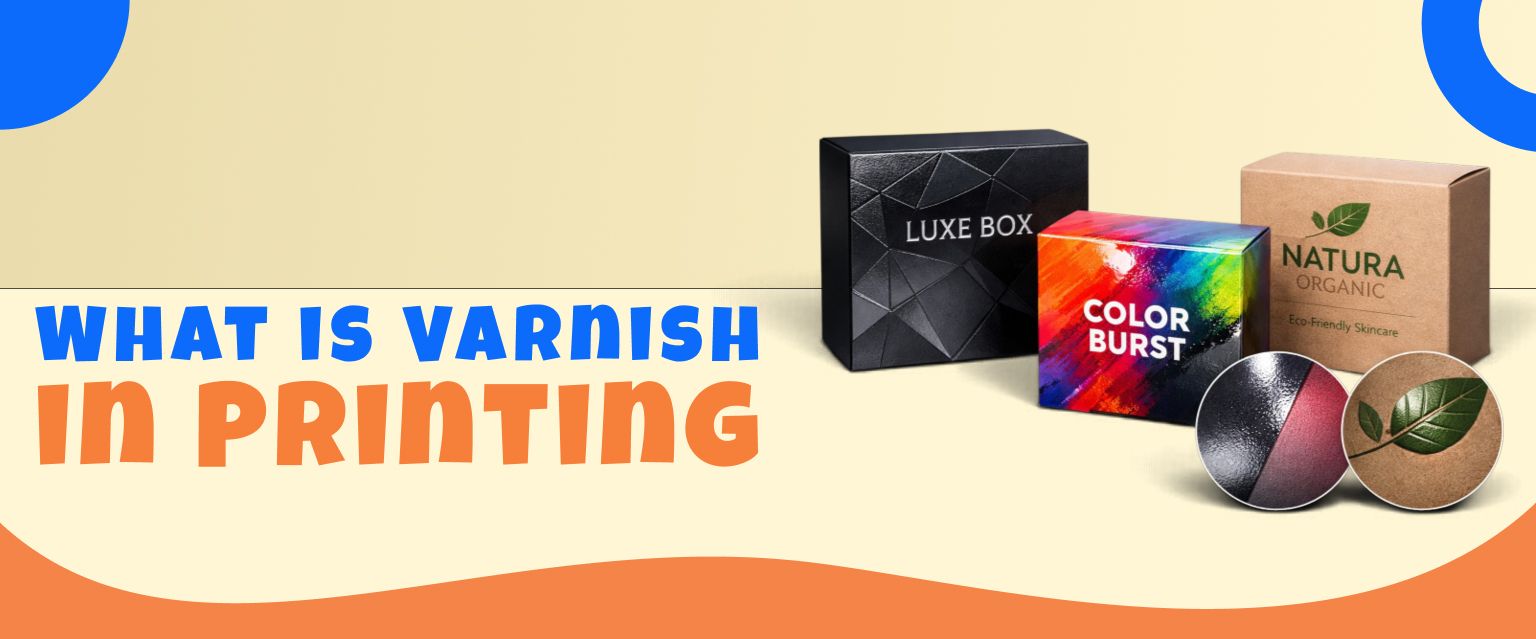
Varnish on boxes is also common. Brands use a varnish layer on boxes to make them survive longer. It is most commonly used for custom boxes. Where styles and looks help brands to make their product look appealing.

Spot Vs Flood: Applied Method

There are mainly two methods of varnish application. The final look and cost of printing will be based on which method you choose. 

Spot Varnish 

So what is spot varnish in printing? Spot varnish is a coating that is applied to a specific area of the paper instead of the whole paper like images, logos and on headlines. 

Flood Varnish

Flood varnish is used on the whole paper edge to edge. It is usually used for the protection of the entire paper. This varnish is also a cheaper option than spot varnish.

Related Coatings Compared With Traditional Varnish

Varnish is not the only option. Some other options are also available with different results.

UV Coating 

UV coating dries up fast under UV light. It offers strong protection and gives glossy, thick and hard finishing. But it is also expensive.

Soft Touch Coating

Soft touch coating creates a soft, smooth surface and gives a different look than other random coatings. Many people use it for Custom Printed Boxes and covers. Because it add expensive look. 

Aqueous Coating

Aqueous is a water-based coating, more eco-friendly than solvent varnish coating, that dries up fast. It is less shiny than UV coating and provides a light protective layer. 

Lamination Coating 

Lamination coating is tougher and thicker than other coatings that are applied on printing materials. It offers the highest level of protection but is also more expensive.

How They Compare To Varnish

Traditional coating is simple and less expensive than varnish. It fulfills the basic requirements and shine needs. Choose according to the budget and printing requirements.

Advantages Of Varnish

  • Varnish acts as a protective layer and helps the printing material to survive longer. 
  • It is less expensive than lamination and UV coating.
  • Helps Custom Retail Packaging Boxes stand out on crowded retail shelves.
  • This is water-based is also more eco-friendly. 

Disadvantages Of Varnish

  • Not as protective as lamination or thick UV.
  • May crack or break on severely folded or creased surfaces.
  • Gloss varnish may provide glare, reducing legibility in bright light.
  • Not suitable for surfaces that are to be written or printed on afterwards.

Varnish Vs Lamination

Varnish is applied directly on the print. It dries fast because it is in liquid form also less expensive and provides moderate protection from scratches. This is suitable for short-term and low-budget projects.

Lamination is a plastic sheet that is usually placed over the printed surface. It offers long-term and stronger protection from damage, but it also costs more than varnish. This can also be applied Custom Gift Boxes to enhance presentation.

Application Of Varnish

Varnish is applied on printing material in different ways. The application of varnish is totally depends on the final goal and method. To make varnish usable for larger runs like magazines, it runs through an extra layer and press.

UV varnish uses a coating that dries in UV light, instantly turning it into a hard and glossy finish that can be used as varnish on boxes and book covers. Soft varnish uses a different coating that is only used on specific areas like logos and images.

Some varnish is applied through a different machine after printing. It is useful for the finish that can’t be done during the print.

Conclusion 

Varnish plays a very important rule in printing. It protects printing material from scratches add shine or a soft look according to need. Every type of varnish serves a different job and purpose and also depends on the budget and design.

This is cheaper as compared to lamination. But it works for short-term and less heavy projects. Varnish can be used on brochures, book covers, or retail packaging; it remains cost-effective and enhances the visual appeal of the print.

If you’re planning your next print or packaging project and want expert guidance on choosing the right coating, Packlim can help you find the perfect finish for your needs.

FAQs

What Is Varnish Coating?

Varnish is a clear coating that is used on printing material to enhance the quality of printed papers. It adds shine and works as a protective layer for printed material that helps to protect papers from scratches and moisture damage.

What Is Spot Varnish In Uv Printing?

In UV printing, spot varnish is a coating that is applied only on specific areas. Then instantly dried under ultraviolet light. It creates a glossy surface, often used for logos, images and headlines on covers.

Which Is Better, Lamination Or Varnish? 

Lamination and varnish both work differently. But the main difference is that varnish is less expensive than. Also, lamination helps printed material to survive long and butvarnish offers short-term protection.

Standard Envelope Dimensions: Different Types And Sizes

The most used envelope size in Canada is #10. The dimensions of #10 are 245 mm x 156 mm (9.6” x 6.1”). This is the maximum size; a standard Canada Post envelope shouldn’t exceed this size. Usually, the standard envelope dimensions in Canada range from 140 mm x 90 mm (5.5 inches x 3.5 inches) to 245 mm x 156 mm (9.6 inches x 6.1 inches). 

We use envelopes every day. Whether you’re using them in an office environment for letters/documents, or at a special occasion for wedding/birthday invitations. If you often struggle to pick a perfectly sized envelope for your inserts, you’re in luck. This blog will guide you through the variety of envelopes we use across Canada. Understanding standard envelope size dimensions makes it easier to pick the right fit for letters, invitations, or important documents

What Are The Dimensions Of A Standard Envelope?

All standard envelope dimensions in Canada range from 140 mm x 90 mm to 245 mm x 156 mm. Envelopes exceeding this range cost more in postage and are referred to as non-standard envelopes. There are various envelope styles such as business/commercial, catalog, booklet, and announcement. 

These designs come in different dimensions. The most used sizes are 7, #9, or #10; they fall in business/commerical category of envelopes. You might be thinking why it is even important to learn standard letter size envelope dimensions; it’s not just random information. You need it for the safety of your inserts and money.

Envelope Dimensions For Standard Postage

Before mailing anything, knowing the standard size envelope dimensions used commonly across Canada will help you. The rule is no different for standard postage. If your letter is larger than standard mailing envelope dimensions, which are 245 mm x 156 mm, it will be referred to as a non-standard envelope. 

You have to pay more for oversized envelopes. The non-standard or oversized envelopes range from 140 mm x 90 mm (5.5 inches x 3.5 inches) to 380 mm x 270 mm (15 inches x 10.6 inches). In short, if the weight of your envelope is under 50 g, it is a standard envelope, and if it weighs more than 50g it is a non-standard envelope. 

The Importance Of Knowing Envelope Dimensions

Information about envelope type and dimensions saves you money. Usually, people are unaware of envelope dimensions, and they crumple their document, putting it in an inaccurate envelope. Don’t be one of them! In the next section, let’s explore types of envelopes and what they are used for. We will also explain all envelope dimensions and the insert sizes you can add to them. 

Types Of Envelopes And Their Dimensions

The envelopes that are used in our daily routine include booklet, business, announcement, and catalog envelopes. Business envelopes are the ones always in demand, so let’s get started with them.

Business/Commercial Envelope

The most used business envelope is #10. It is used for direct mail and transactional purposes. Standard business envelope dimensions are suitable for most common paper sizes. Look at the table below to see standard size 10 envelope. 

These envelopes are offered with open-end, square-shaped flaps with a pointed tip. Business envelopes may be the perfect mailing solution for you because it saves cash and provide a readily useful product. They also have windows, especially #10. The window displays the address from inside rather than printing it outside. Standard window envelope dimensions for a #10 envelope are 4⅛ × 9½ inches, with the window placed about ⅞ inch from the left edge and ½ inch from the bottom.

The Envelope sizes chart for business envelopes will help you select the one you are looking for.

Envelope SizeOverall Measurements Suggested Insert DimensionsTypical Use 
No. 6¾ 92.1 x 165.1 mm (3.625 x 6.5 in) 85.7 x 158.8 mm (3.375 x 6.25 in) Personal letters, small statements 
Monarch 190.5 x 98.4 mm (7.5 x 3.875 in) 184.2 x 92.1 mm (7.25 x 3.625 in) Personal/executive stationery 
No. 9 98.4 x 225.4 mm (3.875 x 8.875 in) 92.1 x 219.1 mm (3.625 x 8.625 in) Invoices, return envelope for No. 10 
No. 10 104.8 x 241.3 mm (4.125 x 9.5 in) 98.4 x 235 mm (3.875 x 9.25 in) Standard business letters (most common) 
No. 12 120.7 x 279.4 mm (4.75 x 11 in) 114.3 x 273.1 mm (4.5 x 10.75 in) Legal documents, larger mailings

When shopping for stationery, checking the dimensions standard envelope sizes come in can save you from ordering the wrong fit.

Catalogue Envelopes

Catalogue envelopes are designed with a single-side seam and a centre seam and are open-ended. The specific design is created so documents or books can be sent without any creases. Usually, these envelopes also come with insulation, like bubble wrap, to keep your insert safe. 

Catalogue envelopes can easily hold an A4 paper because they are available in 228.6 x 304.8 mm (9” x 12”). These envelopes are vertical , designed with an open flap on the shorter dimension. This feature differentiates catalogue envelopes from other envelopes. 

The table below shows Standard envelope size in mm and inches. 

Envelope TypeOverall MeasurementsSuggested Insert DimensionsTypical Use 
#9 x 12228.6 x 304.8 mm (9 x 12 in)222.3 x 298.5 mm (8.75 x 11.75 in)Full-size documents, catalogs, presentation materials
#6 x 9152.4 x 228.6 mm (6 x 9 in) 146.1 x 222.3 mm (5.75 x 8.75 in)Booklets, brochures, small catalogs
#10 x 13254 x 330.2 mm (10 x 13 in) 247.7 x 323.9 mm (9.75 x 12.75 in)Legal documents, large reports, bulky mailings

Booklet Envelopes

The standard size of booklet envelopes is capable of mailing large-sized and large articles that aren’t able to fit in regular envelopes. Booklet envelopes ship your content without folding them. However, you may need to fold smaller sizes. The most common size is 228.6 x 304.8 mm (12” x 9”). 

Booklet envelopes are designed with open-sided and double-sided seams. Their opening flap is on the longer side of the envelope. This feature allows your inserts to slide in without any trouble. These envelopes might have a clasp closure or a tear closure for mailing. If your inserts are heavy or they have to travel long distances during shipping, use cardboard envelopes. 

Internationally, we might see standard envelope dimensions in cm; Canada typically lists envelope sizes in millimeters or inches.

Here are dimensions of standard envelope :

Envelope TypeOverall MeasurementsSuggested Insert Dimensions Typical Use
No. 9½ 228.6 x 304.8 mm (9 x 12 in) 222.3 x 298.5 mm (8.75 x 11.75 in) Marketing kits, larger brochures 
No. 6 146.1 x 225.4 mm (5.75 x 8.875 in) 139.7 x 219.1 mm (5.5 x 8.625 in) Small brochures, folded flyers 
No. 6½ 152.4 x 228.6 mm (6 x 9 in) 146.1 x 222.3 mm (5.75 x 8.75 in) Booklets, half-fold mailers 
No. 9 222.3 x 292.1 mm (8.75 x 11.5 in) 215.9 x 285.8 mm (8.5 x 11.25 in) Full-page documents, letter-size booklets 

Announcement Envelope

Announcement envelopes, also called A-style envelopes, are used for greeting, gift, and wedding invitation cards. These envelopes are open-sided and have a square and deep flap. You can get them in various colours and paperweights. A-style envelopes give rise to innovation and creativity. You can contact a custom printing company to add text or dazzling designs in your favourite colour. 

Standard envelope dimensions in inches and mm of announcement envelopes: 

Envelope TypeOverall MeasurementsSuggested Insert Dimensions Typical Use 
A7 184.2 x 133.4 mm (7.25 x 5.25 in) 177.8 x 127 mm (7 x 5 in) Wedding invitations, formal announcements (most common) 
A2146.1 x 111.1 mm (5.75 x 4.375 in) 139.7 x 104.8 mm (5.5 x 4.125 in)Greeting cards, small notes
A8206.4 x 139.7 mm (8.125 x 5.5 in)200 x 133.4 mm (7.875 x 5.25 in)Large invitations, photo cards

Baronial Envelopes

Like announcement envelopes, baronial envelopes are also used for sending greeting cards, invitations, and personal mail materials. The one small difference is in design. Baronial envelopes have point-shaped flaps, whereas announcement envelopes have square flaps

The size chart of baronial envelopes:

Envelope TypeOverall MeasurementsSuggested Insert Dimensions Typical Use 
4 Bar 130.2 x 92.1 mm (5.125 x 3.625 in) 123.8 x 85.7 mm (4.875 x 3.375 in) Small notecards, RSVP cards (most common) 
5 Bar 142.9 x 104.8 mm (5.625 x 4.125 in) 136.5 x 98.4 mm (5.375 x 3.875 in)Standard greeting cards 
6 Bar 165.1 x 120.7 mm (6.5 x 4.75 in)158.8 x 114.3 mm (6.25 x 4.5 in)Mid-size announcements

The Right Envelope

You can choose the right envelope for your inserts easily if you know all types and sizes.

  • First, see if your content is for business, personal, or formal invitation
  • After identifying the purpose, you can choose the type of envelope.
  • See the dimensions of your insert and accordingly select the right size. 

Conclusion

The standard envelope dimension in Canada is 245 mm x 156 mm. Business is the most used type. However, you can choose catalog, booklet, or announcement if you want. Now you know all types and every dimension they come in. If you want to be creative and want custom-printed envelopes, you can contact Packlim. We have always made our clients happy with our excellent services. 

How Many Cigarettes In A Pack: Guide 2026 

Did you know how many cigarettes are in a pack? Every state follows its own domestic law and the number of cigarettes in a pack is also based on the law. But in Canada, 20 is the minimum in a standard-size pack. Larger or king-size packs contain 25 cigarettes according to the law.

Have you ever noticed every pack of cigarettes you pick up in Canada looks identical? Because it is federal law, not any rule set by the market. According to the Tobacco and Vaping Products Act, “No one can package, import, sell and distribute cigarettes unless the pack has at least 20 cigarettes.”

You can’t buy an individual or will never find a pack with less than 20 cigarettes in Canada because of this law. Other than just the size of the pack, Canada also has strict rules regarding packaging. 

All the packs should be plain. Most of them should be covered with graphic health warnings. In this blog, we will learn the size of a pack and carton, packaging rules, size differences, cost, and tobacco & nicotine content.

How Many Cigarettes Are In A Pack In The Canada

Selling or buying fewer than 20 cigarettes in Canada is not legal. But 25 count cigarettes packs are also available in markets. It is also legal. It is based on the provincial rules of that area and what quantity people want. Sometimes customers consider the brand and the effective cost per pack.

Normally, packs of 25 cigarettes cost less than packs of 20 cigarettes. Also people care more about prices than design now because all packs come in plain packaging. But some brands also use customized cigarette boxes for display. 

Both sizes are placed on store shelves. To avoid buying again soon, some people buy 25-pack cigarettes. And some people prefer a brand or may smoke less than others so they buy 20-pack cigarettes. Along with the number of cigarettes in a pack, many people think about how many puffs are in a pack of cigarettes.

Puffs depend on the size of cigarettes and how someone smokes.

  • One cigarette = 8 to 10 puffs
  • 20-cigarette pack = 160 to 200 puffs
  • 25-cigarette pack =200 to 250 puffs 

Size does not tell exactly about the puffs and how strong cigarettes are. It only tells how many cigarettes are in the box.

Regular Size VS King Size Difference

Difference means the length, pack difference and the burn time of both regular size and king size cigarettes, not the number of packs or their diameter. 

Length 

King-size cigarettes are longer than regular size, regular size cigarettes are 70 to 72mm longer, while king-size is 84 mm longer.

Pack Difference

With the length difference, the pack size is also different for both regular and king-size cigarettes king-size pack is taller than the standard size. 

Burn Time 

Due to its smaller size regular size burns shorter than king size. King size provides an extended smoking experience due to its longer size.

How Many Packs Of Cigarettes Are In A Carton

Do you want to know how many packs in a carton of cigarettes?

  • 20 cigarettes = 01 pack 
  • 10 packs = 1 carton

or

  • 25 cigrattess = 01 pack 
  • 8 pack = 01carton 

This is the most common format followed by many countries.

20 and 25-count cigarette packs are also popular and sold differently in Canada. King size contains 25 cigarettes, usually sold in 8 packs in a carton that also makes a total of 200 cigarettes. So, whether it’s 20 or 25 cigarettes in a pack, it does not affect the carton.

This standard size of 200 cigarettes per carton is set by the government. This helps with pricing, taxation and consistency with other rules. Every brand sells different pack sizes; the carton is still counted as 200 cigarettes.

Tobacco & Nicotine 

Have you ever thought about what is actually packed in a cigarettes it self? Lets learn here

Processed tobacco and nicotine is packed inside the cigarettes. Tobacco is made up physically and nicotine is an addictive chemical that is present naturally in tobacco.

If you ever think about how many grams of tobacco in a pack of cigarettes? You can pack approximately 14 to 20 grams of tobacco in a 20-count pack of cigarettes. It also sometimes depends on the brand and tightness of packing. And in a 25-count pack contains more than that, according to the quantity of cigarettes in a pack. 

As for how many mg of nicotine in a pack of cigarettes? one single cigarette before it is burned contains 10 to 12 mg of raw nicotine. The amount of nicotine drug in a pack of 20-count cigarettes is 200 to 240 mg. It also depends on brand and blending. But the overall amount of nicotine that an average smoker inhales is 1 to 2 mag per cigarette.

For example, if a smoker is using 10 cigarettes per day that means he is inhaling 10 gm of nicotine per day. This number is reduced through inhalation, filtration, and combustion.

Plain Packaging Rule In Canada

Canada has implemented strict rules on tobacco products to prioritize public health warnings and limit brand appeal with plain packaging. Cigarette packs adhere to a set of rules, as opposed to other brands that rely on custom packaging

Standardized Colour

All brands should use a dull colour like brown or olive for packaging. Logos, images, and brand names are not allowed to display on the pack of cigarettes. 

Mandatory Health Warnings

Health warnings should be applied to the pack, covering up to 75% of the pack. It is obligatory to display a health warning to discourage smoking. 

Font Restrictions

Brand name must appear on the pack of cigarettes in standard colour and font size. Remove the visual distinction between the products according to the law. 

Regulated Dimension 

Maintaining the specific measurements of a pack of cigarettes. Length, width and depth must meet specific requirements following a proper rectangular shape. 

Cost Of A Pack Of Cigarettes In Canada

Canada is one of the most expensive countries for tobacco products. According to the industry pricing guide, “cost of cigarettes varies based on brand, location, and tax policy.” Currently, one pack of cigarettes costs between $ 12 and $ 20 in Canada in 2026.

The price of a pack of cigarettes is based on the federal excise duty, sales tax, and provincial tobacco tax. Cost of cigarettes is the same everywhere but the gap comes down due to the tax structure.

Some provinces like Quebec and Manitoba offer lower prices due to lower tobacco taxes. While the Atlantic provinces rank as the most expensive for tobacco products. Newfoundland and Labrador has the highest price, reaching $19 to $21 per pack.

Prices overall vary based on the area and provincial tax rate. But buying in bulk instead of one pack often helps in reducing the cost per cigarette. 

Conclusion

So whenever the question is how many cigarettes in a pack? The answer in one word is 20. 20 is the legal minimum in Canada and also a standard count globally. But a 25-count pack is also legal and available in Canada. 

The number of cigarettes does not affect the packing of the carton. It will always remain the same. If a pack contains 20 cigarettes then in a carton you will get 10 packs. And if a pack contains 25 cigarettes then in a carton you will get 8 packs. Beyond the cigarette count, Canada also has a strict plain packaging law, provincial tax structure and tobacco and nicotine content regulations. 

No matter if you are comparing king size vs regular size, the price of a pack or full carton and the amount of nicotine or tobacco, these details help you to understand the product and its legal status. This product follows more rules than how it looks.

For more details on how packaging regulations compare across the industry, explore Packlim.

FAQs 

How Many Cigarette Packs Come In A Carton?

A carton has 10 packs of 20-count cigarettes and 8 packs of 25-count cigarettes, making a total 200 cigarettes in a carton. The large pack or regular pack doesn’t matter whether you purchased it in a carton or not. 

How Many Cigarettes Are In A Standard Pack? 

In Canada, there are 20 cigarettes in a standard pack, while in a large size 25 cigarettes in a pack. But according to the law, you can not buy or sell an individual or less than a 20-cigarette pack in Canada

Are King Size Cigarettes Stronger Than Regular Size? 

No, they have the same amount of tobacco in both. King-size cigarettes are not stronger than regular-size cigarettes. Larger size cigrattes is just a larger then regular size cigrattes but not stronger than regular. 

Let’s Book A Free Consultation

Discuss your packaging needs with our consultants free of cost by receiving a free call from our service center.

Use one of 2 options to approach us: