
Flexographic printing is often called flexo printing. It is a modern printing technique widely used in the packaging and labeling industries. This rotary printing involves flexible plates which are used to transfer ink onto various substrates.
Flexographic printing began in Liverpool in 1890 with Bibby, Baron, and Sons’ water-based ink press, dubbed “Bibby’s Folly” due to smearing. Early 1900s European presses used rubber plates and aniline oil-based inks called “aniline printing” or “Gummidruck”. In Germany where the process originated and still retains that name. It was widely used in U.S. food packaging in the early 20th century until the FDA banned aniline dyes in the 1940s causing sales to drop despite FDA reapproval in 1949.
The flexographic process was renamed in 1951 after an industry poll and since 1990, advances like photopolymer plates, digital direct-to-plate systems, laser-etched anilox rolls, and chambered ink systems have enabled near-lithographic print quality with improved color and tonal reproduction. In this article, we’ll explore the key elements of flexo printing.
Process of Flexographic Printing in Steps
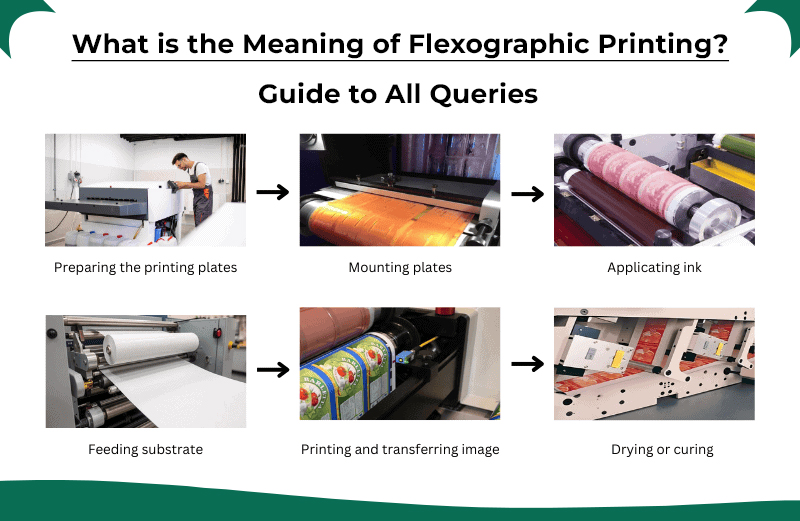
The flexographic printing process may sound technical. Here’s how it works step by step:
First preparing the printing plates is fundamental. These plates are made from resilient rubber or flexible photopolymer materials. Each plate corresponds to a specific color in the design, typically separated into at least four process colors (CMYK). These plates are essential to accurately transfer the image or text onto the substrate.
Next is plate mounting where each prepared plate is securely fitted onto a press cylinder. Accurate alignment (register) of each plate is essential for color precision and image sharpness as even slight misplacement will cause color shifts and blurring.
The ink application stage uses a system of ink chambers, rubber rollers, and specially designed anilox rollers. Anilox rollers have microscopic engraved cells that meter out a precise volume of ink ensuring consistent and uniform ink transfer onto the plate surface. This will result in sharp and vibrant prints.
Following this the substrate feeding system introduces the printing material usually paper or plastic film in roll form into the press. The substrate is guided through the press using tension-controlled rollers.
During the printing and image transfer simply the inked plates press against the substrate with calibrated pressure. This pressure enables efficient ink transfer producing detailed images ideal for high-resolution printing on various materials. Finally then the ink is fixed by drying or curing the print.
This cycle repeats at high speed, allowing mass production with consistent quality.
Inks Used in Flexographic Printing for Better Results
Modern flexographic printing machines are capable of handling multiple colors and substrates. Different products demand different ink properties. Commonly used inks include:
- Water-based inks are considered ideal for paper and cardboard packaging.
- Solvent-based inks are suitable for plastic films, foils and other non-porous materials.
- UV-curable inks provide sharp quality and quick drying with UV light.
This flexibility makes flexo printing adaptable across industries.
Substrates Used in Flexographic Printing for a Unique Look
Flexographic printing works on a wide variety of substrates which is why it’s so popular. Some of the common substrates include:
- Paper and cardboard
- Plastic films like polyethylene and polypropylene
- Metallic foils
- Corrugated boards
- Self-adhesive labels
This broad compatibility allows industries to use one printing method across different packaging types.
Advantages and Drawbacks of Printing with Flexography
The flexo printing process has certain benefits and drawbacks.
| Advantages of Flexo Printing | Disadvantages of Flexo Printing |
| High-speed production | Plate creation and press setup can be expensive |
| Works on many substrates (paper, plastic, etc.) | Not ideal for fine details or photographic images |
| Cost-effective for large volumes | Plates degrade over time and need replacement |
| Quick-drying inks that help speed up production and reduce smudging | Maintaining exact color consistency is challenging |
| Ideal for packaging that requires handling and storage |
Overview of Flexographic Printing Press Operation
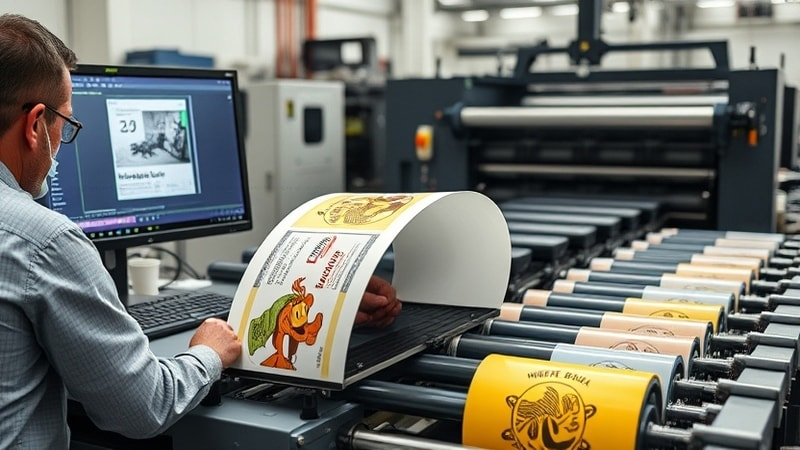
A flexographic printing press uses flexible plates and rollers. It operates like a high-speed stamp capable of printing up to 2,000 feet per minute.
Five main types of flexo presses are categorized by their design and applications:
Stack Press: Vertical stacked decks print on both sides of the material in a single pass; common for flexible materials.
Central Impression (CI): It simply features a large central impression cylinder with printing units arranged around it. Moreover it offers precise registration and high-quality printing. Ideal for flexible packaging.
In-Line Press: In this the decks are aligned horizontally in a straight line. It is suitable for heavier substrates like corrugated cardboard and allows additional finishing processes.
Wide-Web Press: These presses are designed for large-scale printing on wide rolls over 18–20 inches. It is commonly used for flexible packaging.
Narrow-Web Press: These presses are initially for label printing. It is typically under 10 inches wide and has now extended to 20 inches for short runs in packaging like bottle wraps and small pouches.
These types vary in configuration to cater to different substrates, print quality needs, and production volumes.
What is the Difference Between Digital Printing and Flexo Printing?
The debate of flexographic printing vs digital printing is common in packaging. Here are the key differences:
- Flexographic Printing uses plates and is ideal for bulk production, fast, and cost-effective for high volumes.
- Digital Printing uses no plates and is perfect for small runs. Plus it offers better detail and variable data printing. But it can be more expensive for large volumes.
Flexographic Printing vs Offset Printing Difference
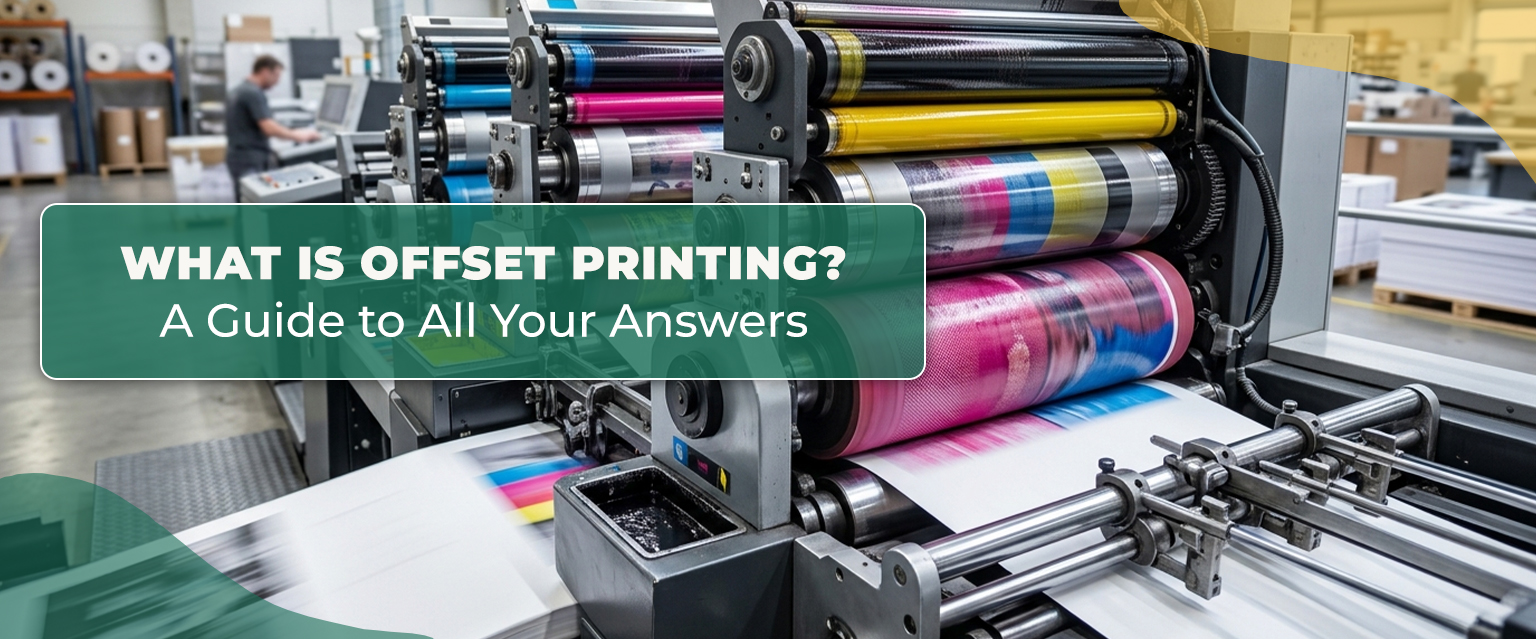
A common comparison is flexographic printing vs offset printing. Offset printing uses metal plates and transfers ink through a blanket before reaching the substrate. Flexo, on the other hand, uses flexible plates and prints directly.
- Flexographic Printing is best for packaging, labels, films, and flexible materials.
- Offset Printing is best for books, magazines, newspapers, and fine-quality graphics.
Both methods have their place but flexography is unmatched in packaging and product labeling.
Conclusion
Flexographic printing is one of the most reliable and efficient printing methods. And especially in the packaging industry it serves its unique role. With its ability to print on diverse substrates at a fast production speed, it has become the backbone of modern packaging solutions.