

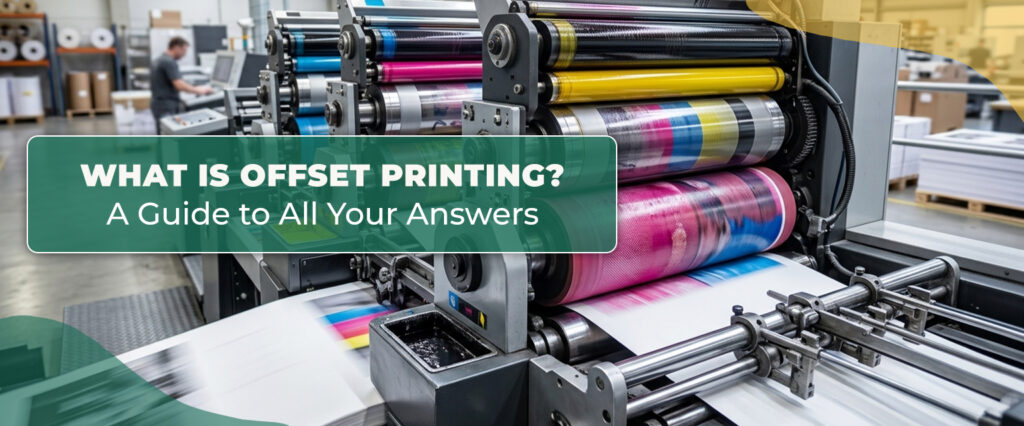
Offset printing is a planographic printing technique where an inked image is transferred from a plate to a rubber blanket cylinder, and then “offset” onto a printing surface like paper, metal, or cloth.
If you’ve ever picked up a newspaper, magazine, or brochure there are chances that you’ve seen the results of offset printing. It’s one of the most popular and widely used printing methods in the world, including here in Canada.
But how did the trend go too real in Canada? Offset printing in Canada became prominent in the mid-20th century. In the 1950s, offset printing started to significantly shape Canadian publishing, allowing for faster, more efficient production and higher-quality books, newspapers, and catalogues.
In this blog, we will delve into some of the details about the offset printing options.
What is Offset Printing?
Offset printing is a printing technique where an image is first transferred. It is transferred from a metal plate to a rubber blanket and then onto paper. It’s called offset because the ink doesn’t go directly from the plate to the paper. It makes a stop at the rubber blanket first. This method is especially useful for printing large volumes quickly and with high quality.
How Does Offset Printing Work? Steps to Ensure Clean Printing Procedure
The process starts with a flat printing plate. This plate contains the image that needs to be printed. Here’s a step-by-step overview:
- Plates are prepared: First, the plates are constructed with accuracy. Each printing plate is created for one colour such as cyan, magenta, yellow, or black (CMYK).
- Ink and water are applied: Then after that, the water sticks to the blank areas (non-image parts), while ink sticks to the image areas.
- Image is transferred: After that, the plate transfers the inked image to a rubber blanket.
- Paper gets printed: Then at last, the rubber blanket presses the inked image onto the paper.
Then ensure the system is stable and accurate as you must see on the screen.
Compliance Standards and Regulations
Before the final product, make sure to also comply with regulations for the industry. The industry often relies on standards like ISO 12647-2 for process control and colour quality consistency. The Standards Council of Canada through the Canadian General Standards Board also sets standards for materials like printing inks for offset presses.
Types of Offset Printing Options
If you are a business owner or looking for packaging printers then you must go through the various variations in offset printing. There are two main types of offset printing such as
- Sheet-fed where individual sheets are fed into the machine.
- Web-fed where large rolls of paper run continuously through the press.
Web-fed presses are often used for newspapers and magazines, while sheet-fed presses are great for flyers, business cards, and packaging.
Why is Offset Printing So Popular in Canada?
Offset printing offers several advantages especially for businesses and organizations that need high-volume printing:
High Quality
Offset printing delivers sharp images and vibrant colours. The rubber blanket molds to the texture of the paper which helps create clean and consistent prints even on rough surfaces.
Cost-Effective for Large Runs
If you want printing on thousands of copies then offset printing becomes more affordable than digital printing. Moreover you can also get discounts on it from multiple sites.
Fast & Efficient
Modern offset presses can print thousands of sheets in a short time. Many presses can print on both sides of the paper in a single pass which saves even more time.
Top Notch Finishes
Offset presses can print on a wide range of paper types and sizes, and can be customized for different finishes (glossy, matte, etc.).
Examples of Offset Printing in Various Industries
There are certain examples of the products on which the offset printing has been done, such as:
- Newspapers like The Globe and Mail
- Magazines like Maclean’s
- Flyers, brochures, and product packaging
- Books and academic materials
- Business cards and letterheads
- More
Is Offset Printing Environmentally Friendly?
The printing industry in Canada has made great strides in sustainability. Many offset printers now use:
- Vegetable-based inks (instead of petroleum-based)
- Recycled paper
- Closed-loop water systems to reduce waste
- Energy-efficient presses
- More
Words to Conclude
Offset printing remains one of the most reliable and economical ways to print high-quality materials in Canada. This type of printing can deliver professional results at a great price especially when printing in bulk. But it’s better to choose the manufacturers that can help you with better offset printing results.